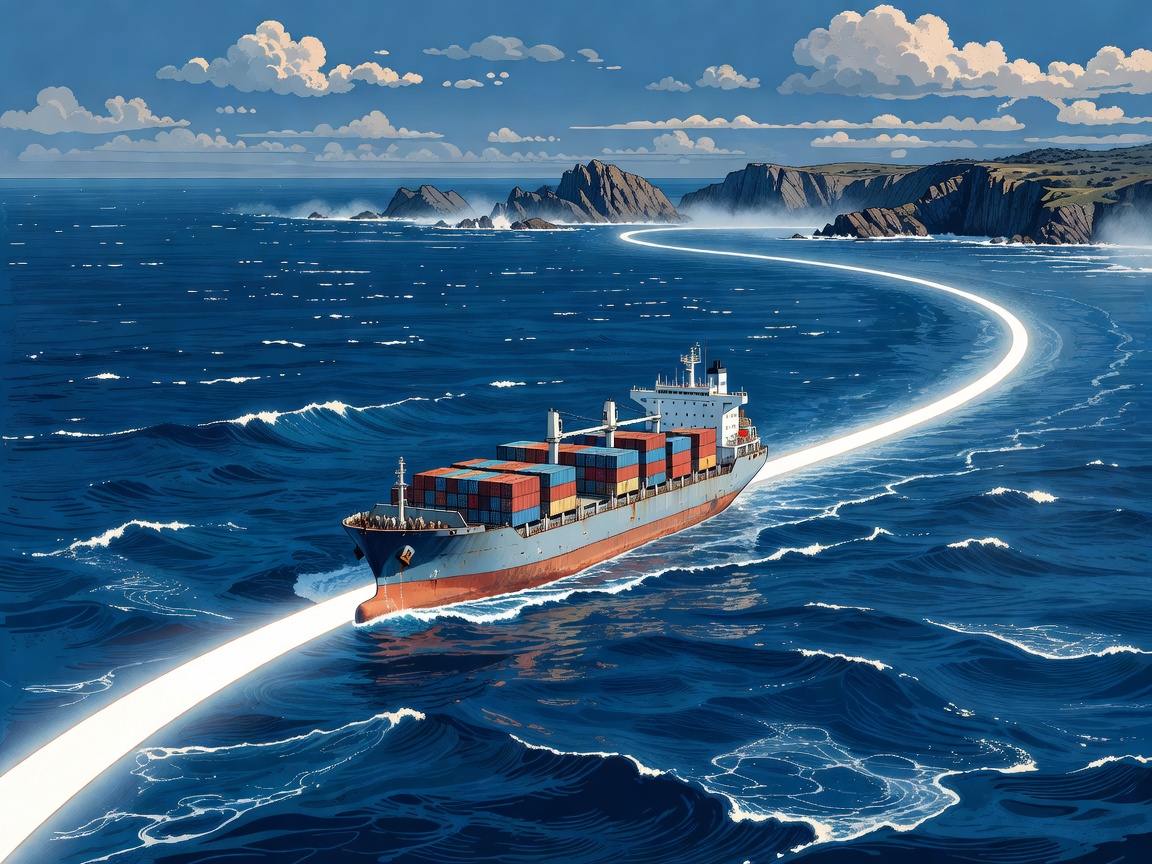
A route planner starts with a practical question: given the voyage, vessel and conditions we know about, which options are worth considering? AI-assisted planning can help explore that question at scale. It remains decision support, not a substitute for navigational judgment.
What “AI-assisted” route planning means
Conventional passage planning is built around charts, applicable rules, vessel knowledge, voyage objectives and professional review. A human planner identifies constraints, selects a route and checks that the plan fits the operation. Digital tools can organize chart information, calculate distances and display information more quickly, but the underlying method may still be straightforward computation.
Rule-based optimization adds explicit priorities and conditions: avoid a defined area, respect a draft-related constraint, or favor a preferred arrival window. It can search for a route that best fits those programmed rules. AI-assisted systems may use learned patterns, predictive models or optimization methods to compare more combinations or estimate how different conditions could affect a voyage. The label “AI” alone tells you very little about which technique is inside, what it was trained or configured to do, or how its output should be interpreted.
Useful planning depends on context. Voyage objectives can include schedule, fuel planning, comfort or operational flexibility. Vessel characteristics matter too: dimensions, maneuverability, draft, loading condition and operating limits can change which alternatives make sense. Navigational constraints, such as traffic arrangements, restricted areas, charted hazards and port requirements, also shape the feasible route. Environmental inputs may include forecast wind, waves and currents, provided suitable data are available and current enough for the purpose.
Three approaches, different strengths
| Approach | What it typically does | Useful strengths | Questions to keep in view |
|---|---|---|---|
| Conventional planning | Uses charts, procedures, experience and established digital tools. | Clear human ownership and familiar review practices. | How much manual collation is involved? Are inputs current? |
| Rule-based optimization | Searches options against explicit constraints and priorities. | Repeatable comparisons; rules can be inspected. | Are rules complete, correctly configured and maintained? |
| AI-assisted decision support | May estimate outcomes or compare complex combinations of inputs. | Can help surface alternatives that merit further review. | What assumptions, data quality limits and uncertainty accompany each suggestion? |
These categories overlap in real systems. One product may combine conventional calculations, fixed rules and learned models. It’s more useful to ask what each function does than to debate whether the whole system “is AI.”
Alternatives, estimates and changing conditions
A planner may compare route alternatives by estimated arrival time, distance, fuel-related considerations or exposure to conditions that matter to the vessel. These are trade-offs, not a universal scorecard. A shorter path might be less attractive if it creates operational constraints; a route with a different estimated arrival may better fit a vessel’s priorities. Any estimate depends on assumptions about speed, loading, consumption, weather, currents and other variables. Ask how those assumptions are surfaced, rather than treating a neat number as a promise.
Conditions change. A forecast is not an observation, and a route selected earlier may need a fresh review when new information arrives or the voyage context shifts. A useful system should help people compare revised options and understand what changed. It shouldn’t quietly turn a recommendation into an instruction.
Most importantly, optimization is not proof of safety or compliance. A model can optimize the objective it was given while missing a relevant constraint, relying on stale data or representing an uncertainty poorly. Qualified personnel still need to assess the plan against current nautical information, vessel-specific procedures, applicable requirements and the actual situation.
Advantages, limitations and practical evaluation
Potential advantages include less repetitive comparison work, a clearer view of alternatives and a consistent way to explore scenarios. Potential disadvantages include dependence on data quality, hidden assumptions, brittle rules, integration effort and overconfidence in polished outputs. A recommendation can look authoritative even when the inputs are incomplete. That’s a user-interface problem as much as a modelling problem.
When comparing systems, ask whether constraints are visible and editable; how the tool handles missing, stale or conflicting data; whether it explains why routes differ; and how uncertainty is represented. Check what vessel particulars and external data are required, how often those sources update, and what happens when a connection or feed is unavailable. Ask whether the system integrates with existing bridge workflows without creating duplicate entry or conflicting displays.
Evaluation should use representative scenarios, including ordinary voyages and awkward edge cases: changing conditions, incomplete inputs, unusual vessel characteristics and constraints that matter to the operation. Review outputs with the people who will use them. Training should cover both the controls and the limitations. Finally, clarify cybersecurity, access management, update practices, support arrangements and the route for reporting a concern.
Before an evaluation, an operator might ask: What exactly is being recommended? Which inputs influence it? Can I see the constraints and assumptions? How does it communicate uncertainty? Who remains responsible for review? What evidence supports performance in scenarios relevant to this vessel and voyage? Those questions make a better starting point than a shiny “optimal route” badge.
For the environmental side of the picture, continue with weather-aware navigation. For how suggestions fit into human-supervised workflows, see navigation decision support.
This guide is educational and general. It is not live routing advice, a navigational aid, or a replacement for current charts, notices, vessel procedures or qualified maritime personnel.